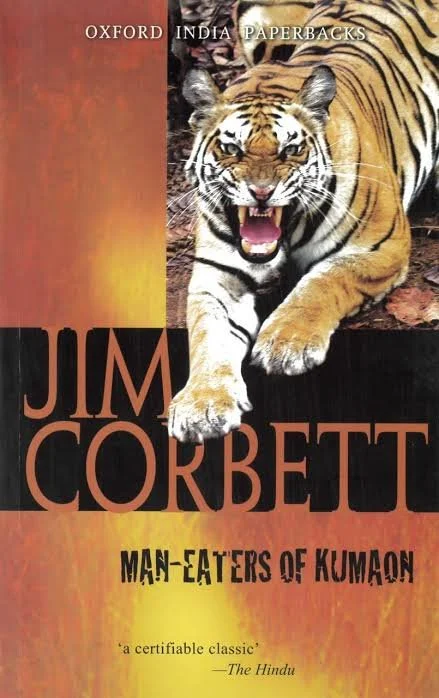
Man-Eaters of Kumaon
/Jim Corbett was born and raised in colonial India and worked as an official for a British railway in the subcontinent for twenty years. He was a keen outdoorsman and hunter but not a professional. Despite this, in 1907, when he was in his early thirties, he was asked to travel to Kumaon in northern India to kill a man-eating tiger. The tiger had originally come from Nepal, where it learned to hunt humans, but its depredations had grown so severe that it was driven out of the area and into India by a mass “beat,” with hundreds of beaters walking in line abreast through the forests and fields to flush the tiger and run it out.
This, Corbett’s first man-eater, was the Champawat tiger, and by the time he arrived in northern India, stalked, and shot it, the tiger had killed and eaten over four hundred people.
Man-Eaters of Kumaon, published in 1944, tells this and several other hair-raising stories spanning almost thirty years, but Corbett, in a sign of his priorities and character, begins the book with an explanation of why tigers become man-eaters. Tigers and leopards do not normally eat people, Corbett tells the reader. They avoid humans. If a tiger begins eating people it has been driven to do so because of age, injury, or disability—something that turns it from hunting its usual prey in its usual style to softer targets. If your picture of the man-eater is Disney’s svelte and powerful Shere Khan, as mine at least partly was, remember that the Shere Khan of Kipling’s book is lame in one leg.
The Champawat tiger, he discovers, was an ageing tigress with two broken canine teeth. Another had lost an eye to a porcupine and had dozens of quills in the muscles and pad of one of its forelegs. Another was an old, slow tigress with a cub to feed.
Corbett begins with that long note on what causes tigers and leopards to eat humans and the book only gets more interesting from there. Though never laying out in point-by-point detail what signs he’s looking for as he stalks a tiger and examines its tracks, one picks up a lot from each story. In addition to the drama of the hunt—near misses, near-fatal surprises, and the suspense of searching, planning, and lying in wait—each story is an education. The age, sex, and size of the tigers matter as well as the local environment and what the local people do. Many victims are snatched from fields where they’re cutting grass or harvesting wheat. Others are taken while gathering firewood or cutting down trees. Each story is different and each, even if they have the same outcome, follow surprising trajectories.
But it’s almost certainly the drama that will lead one to pick up a book like this, and Corbett delivers. In perhaps the most thrilling hunt Corbett stumbles upon the man-eater he’s hunting on a rocky forested hillside, half-turned, with only one hand on his rifle and the tiger lying mere feet away. His coolness, experience, and skill are what save him, though I don’t want to give away how.
I’ve already mentioned Corbett’s character, and that’s an important part of the story and what it is like to read Man-Eaters of Kumaon. Corbett is no Hollywood stereotype of the big game hunter. From the start, hunting the Champawat tiger in his early thirties, Corbett seeks no reward and asks the government to cancel bounties placed on the man-eater. He respects the locals, knows their languages and customs, and singles many of them out for their bravery under the circumstances. One especially vivid example is a woman who, while cutting grass with her sister, saw a tiger attack and drag her sister away. Rather than run, she pursued the tiger and attacked it with her sickle. It was too late for her sister, but Corbett admired her guts and made it a point to speak to her when he arrived and to show her the tiger’s carcass before he left.
Corbett is also no braggart. Though exceptionally skilled he freely admits to mistakes—including at least one that, he owns with open regret, allowed a tiger to escape and kill more people—and tells plenty of stories about missed or botched shots and errors of judgment. Even when he records the dimensions of his quarry after a successful hunt he notes that the figures are worthless as they cannot be corroborated. His self-effacing manner also allows the book to be funny on occasion, as in one episode in which he takes multiple shots at a tiger that leaves and returns several times with no apparent effect, only to discover that he has shot at multiple tigers and killed two.
Another important aspect of Corbett’s character, and one that makes the book especially refreshing to read, is his dispassionate account of the animals he hunts. Whether tigers, leopards, or—in one outlier chapter—fish, Corbett describes them without anthropomorphism. This attitude conveys a respect for the animals and a sympathy that stops well short of sentimentality. Once a tiger has taken to man-eating, it must be killed, but Corbett does not approach his job as a game and the only satisfaction he takes in it is ridding the people of Kumaon of a deadly menace.
And Corbett never loses sight of that menace. He never ignores or downplays the human toll of the tigers’ attacks and narrates the killing and eating of dozens of people with neither coldness nor showy emotionalism. Sons, daughters, sisters, wives, mothers, husbands, and fathers are killed, and Corbett makes it clear that these are serious and painful losses. The story of one man, a veteran of an Indian regiment in the British army whose only son is killed just after enlisting, is especially powerful.
Man-Eaters of Kumaon mostly focuses on the stories of big cats Corbett was commissioned to kill, but one chapter concerns a trophy hunt for a huge, magnificent male tiger known as the Bachelor of Powalgarh, another—mentioned above—is about fishing, and the final short chapter is about Corbett’s late-life interest in photographing and filming tigers. (Here’s a sample of his footage.) Never concerned about glory or trophies, Corbett was a conservationist who wanted the best for both man and animal. While never blaming humanity, he points out that many man-eaters were made by careless hunting—taking a shot at a tiger and not finishing it off or overhunting a tiger’s normal prey. Fittingly, India’s first national park was named after him and, thanks to conservation efforts, now has the densest population of wild tigers in the world.
“[H]aving lived most of my life in the jungle,” Corbett writes near the end, “I have not the ability to paint word-pictures.” On the contrary. Corbett’s stories are a testimony both to simple, strong, unaffected writing and to a life well-lived. I’m not sure where I first heard of Man-Eaters of Kumaon, but I’m glad I did. While I expected it to be interesting, to my great surprise it is one of the most interesting and dramatic books I’ve come across in years. I highly recommend it if you need something to shake up your reading.